Affiliate disclosure: Cross Stitch Expo may earn a commission from qualifying purchases made through links on this page, at no additional cost to you. How we choose what we feature.
Walk into a needlework shop—or browse one online—and it can appear that cross stitch requires dozens of specialized tools.
It doesn’t.
A beginner can start with a surprisingly small set of supplies.
The important thing is choosing the right basics rather than buying everything that looks useful.
 The Essential Starter Kit
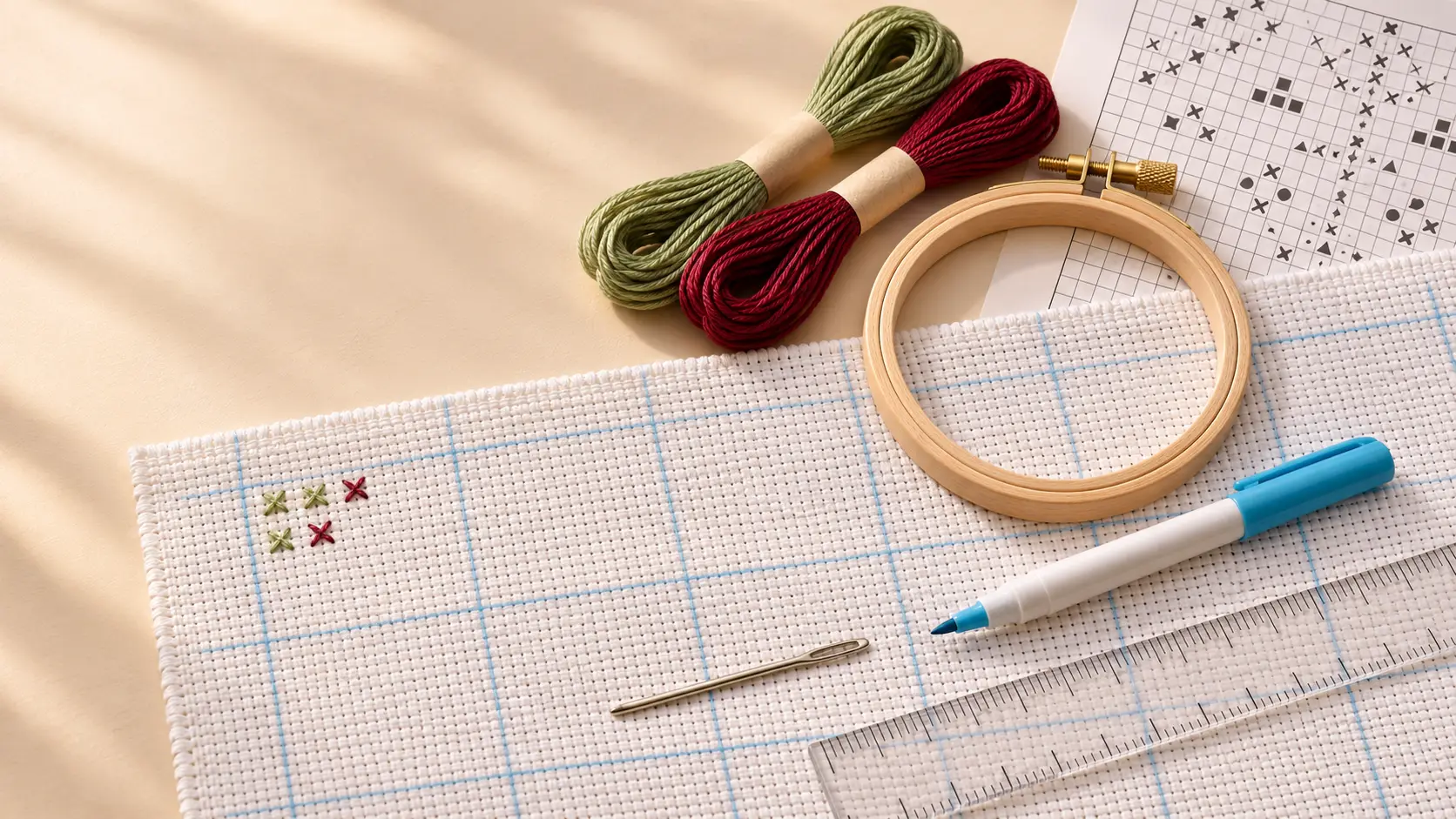
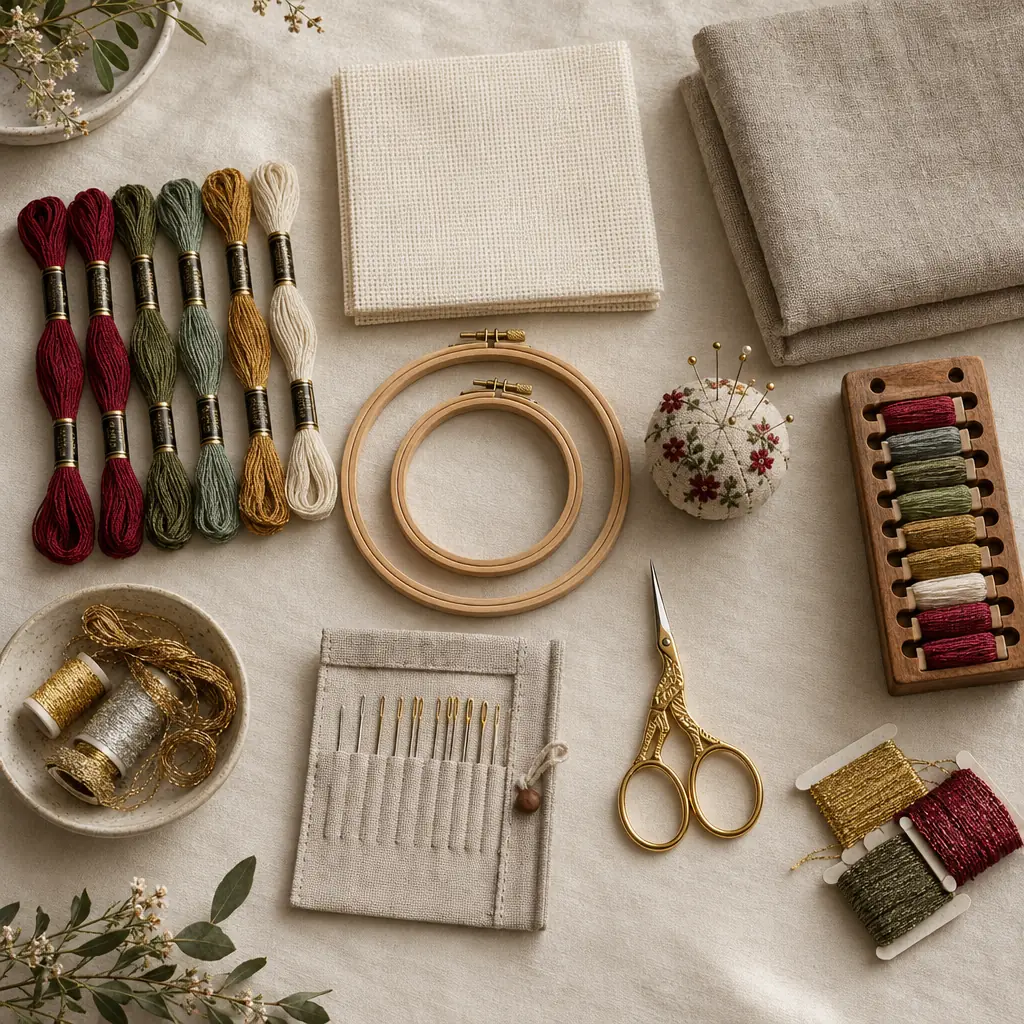
For your first cross-stitch project, concentrate on six things:
- A pattern
- Fabric
- Embroidery floss
- Tapestry needle
- Small scissors
- A way to hold the fabric comfortably
That’s enough to begin.
DMC’s own beginner learning kit follows essentially this formula, supplying 14-count Aida, embroidery floss, a needle, hoop and instructions.
 1. A Cross-Stitch Pattern
Your pattern is the roadmap.
For a first project, look for:
- A relatively small design
- A limited number of colors
- Mostly full cross stitches
- Clearly printed or displayed symbols
- A complete thread key
- Finished dimensions
- Fabric recommendations
You do not need the easiest-looking artwork.
You need the easiest construction.
A simple geometric or floral design with eight colors may be much friendlier than a tiny illustration using forty colors and constant thread changes.
 2. Fabric
Aida is the simplest starting fabric for most beginners.
Its weave forms obvious squares and holes, making it easier to see where each stitch belongs. Zweigart specifically describes Aida as having clearly defined stitch squares that simplify counting.
DMC recommends 14-count Aida for beginners. The number 14 means that 14 stitches fit into one inch of fabric.
You will eventually encounter linen, evenweave and many specialty fabrics.
You don’t need to master them on day one.
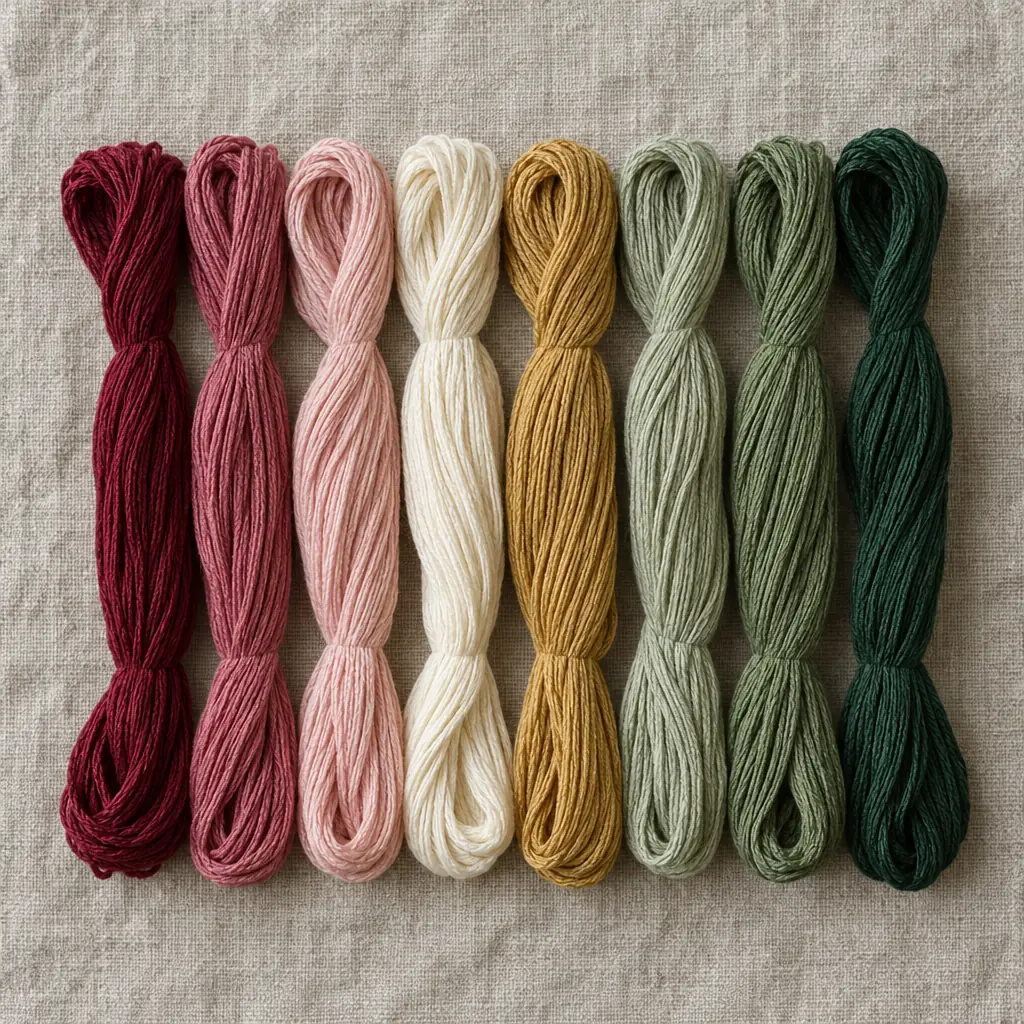
 3. Embroidery Floss
Standard cotton embroidery floss is usually stranded, meaning multiple finer strands are twisted together.
DMC’s common cotton floss contains six separable strands, allowing stitchers to choose how much thread to use.
Your pattern should tell you which colors and how many strands are required.
Do not assume that because a skein contains six strands you should stitch with all six.
Separate only what the pattern calls for.
For many projects on 14-count Aida, two strands are a common starting point.
 4. Tapestry Needle
Choose a tapestry needle rather than a sharp sewing needle.
Tapestry needles have a blunt point and relatively large eye. Their purpose in counted needlework is to pass through the existing holes in the fabric without splitting the fabric threads unnecessarily.
Needles come in several sizes.
You will eventually learn to match size to fabric count and personal preference.
For your first project, a kit or pattern recommendation can make that choice for you.
 5. Small Scissors
You don’t need specialty scissors to make your first stitch.
You simply need a clean, sharp pair capable of cutting embroidery floss neatly.
Small needlework scissors are convenient because they are easy to keep with a project and make precise trimming easier.
The tiny decorative stork scissors can come later.
 6. A Hoop, Q-Snap or Frame
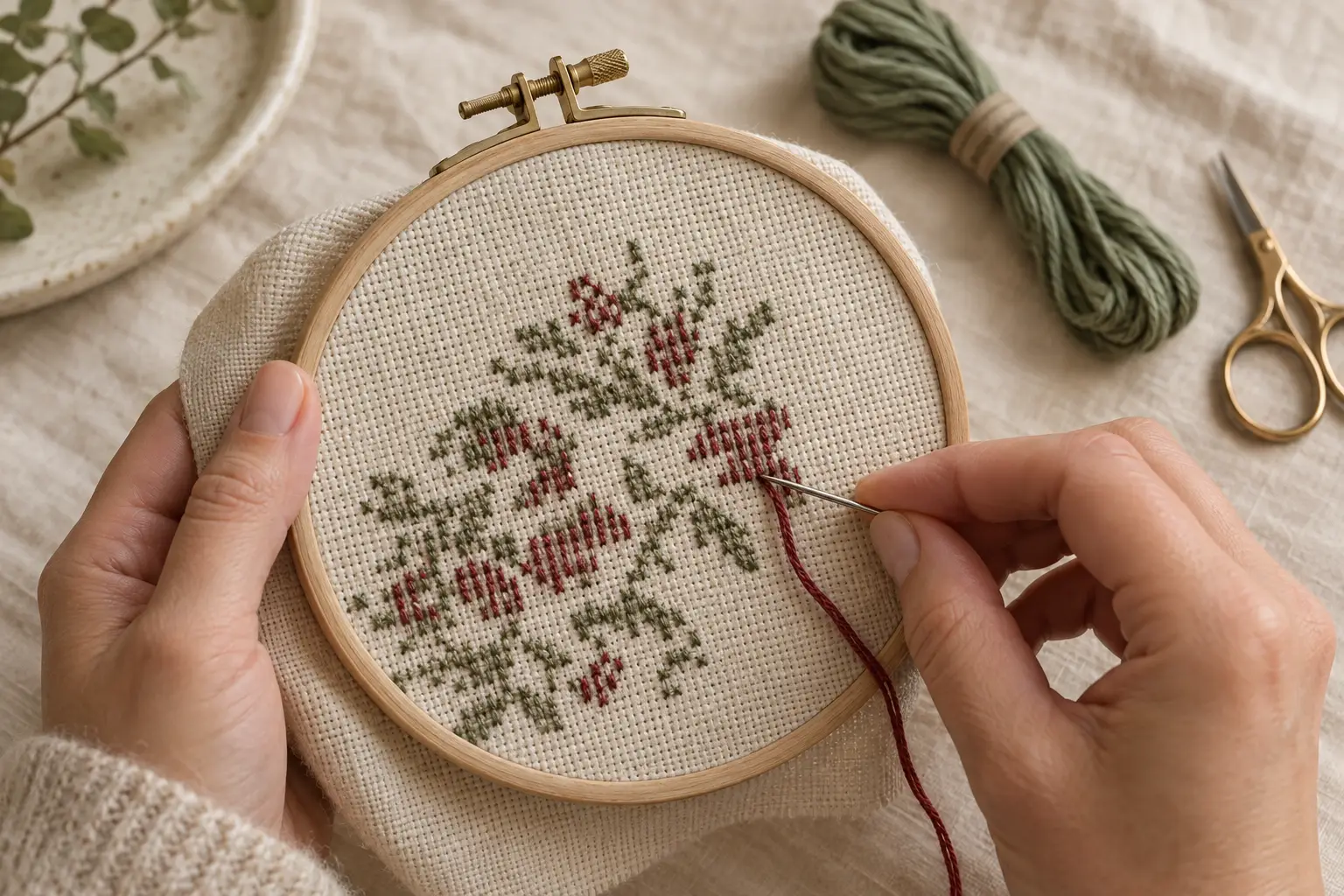
Many beginners use an embroidery hoop because it is inexpensive, simple and widely available.
Its job is to help hold the fabric at a comfortable tension while you stitch.
Some stitchers prefer Q-Snap-style frames. Others stitch in hand. Large-project stitchers may eventually use scroll frames or floor stands.
There is no universal requirement that every cross stitch project must be stitched in a hoop.
For your first project, use whatever helps you keep the fabric comfortable and manageable.
 Useful Extras
Once you’ve made a few stitches, several inexpensive extras can improve the experience.
Needle minder
A magnet that gives your needle somewhere safe to rest instead of disappearing into a sofa.
Thread organizer
Useful when a pattern contains many colors or symbols.
Project bag
Keeps fabric, floss, chart and tools together.
Highlighter or chart-tracking tool
Helpful when following larger printed charts.
Good light
More useful than many specialized gadgets.
If you find yourself leaning toward the fabric or struggling to distinguish holes and colors, improve your lighting before assuming you need more skill.
 Things You Don’t Need Immediately
You do not need a floor stand.
You do not need hundreds of floss colors.
You do not need expensive embroidery scissors.
You do not need elaborate thread storage.
You do not need a magnifier unless it genuinely helps you see comfortably.
And you do not need to build a giant stash before completing your first project.
Buy for the project you are actually going to stitch.
Then let your supplies grow naturally with your interests.
Should You Buy a Kit?
A good kit can be an excellent first purchase because it removes several decisions.
Instead of selecting fabric, thread colors and a needle separately, you receive materials chosen for one specific design.
Before purchasing, check what the kit includes.
Some contain nearly everything.
Others may require you to provide a hoop, scissors, finishing materials or additional tools.
The Cross Stitch Expo Beginner Shopping List
For a first non-kit project, start with:
- One beginner-friendly pattern
- Enough 14-count Aida for the project plus finishing allowance
- The floss colors listed in the pattern
- One appropriate tapestry needle
- One small pair of scissors
- One hoop or preferred fabric holder
That’s enough.
 What to Learn Next
- How to Read a Cross Stitch Chart
- Aida vs Linen vs Evenweave
- Cross Stitch Fabric Counts Explained
- How to Choose Your First Pattern
- How to Choose a Cross Stitch Kit
A good needlework setup should make stitching easier.
It should not become another project you have to manage.
Start simple.
Discover what you actually enjoy using.
Then add tools because they solve a problem—not because someone told you every stitcher needs them.