Affiliate disclosure: Cross Stitch Expo may earn a commission from qualifying purchases made through links on this page, at no additional cost to you. How we choose what we feature.
“14-count.”
“32-count over two.”
“18-count Aida.”
Fabric-count language can make cross stitch sound far more technical than it is.
The basic idea is simple:
The count tells you how many fabric units fit into one inch.
On Aida, that translates directly into the number of cross-stitch squares per inch.
DMC explains that the count of Aida represents the number of stitches that can be made in an inch; a higher count creates smaller stitches.
 The Most Common Aida Counts
11-count Aida
Eleven stitches per inch.
The stitch squares are relatively large.
This can be comfortable for bold projects or stitchers who prefer larger holes.
14-count Aida
Fourteen stitches per inch.
This is one of the most common beginner choices.
DMC specifically recommends 14-count Aida as a beginner-friendly fabric.
16-count Aida
Sixteen stitches per inch.
The stitches are slightly smaller than on 14 count, giving the project a finer appearance and reducing its finished dimensions.
18-count Aida
Eighteen stitches per inch.
Smaller stitches create a more compact, detailed result.
Zweigart currently produces Aida in 14, 16, 18 and 20 counts, illustrating the range of commonly available stitch densities.
Higher Count = Smaller Finished Design
Imagine a pattern that is 140 stitches wide.
On 14-count Aida:
140 ÷ 14 = 10 inches
On 16-count Aida:
140 ÷ 16 = 8.75 inches
On 18-count Aida:
140 ÷ 18 ≈ 7.8 inches
The pattern hasn’t changed.
Only the size of each stitch has.
This is one reason fabric count matters when planning framing, ornaments or projects that must fit a specific finished size.
 The Simple Finished-Size Formula
For Aida:
Pattern stitch count ÷ fabric count = stitched size in inches
If your design is 196 stitches wide on 14-count Aida:
196 ÷ 14 = 14 inches.
Do the same calculation for the height.
Then remember that your fabric itself must be cut larger than the stitched design so you have enough room to hold, finish and frame the project.
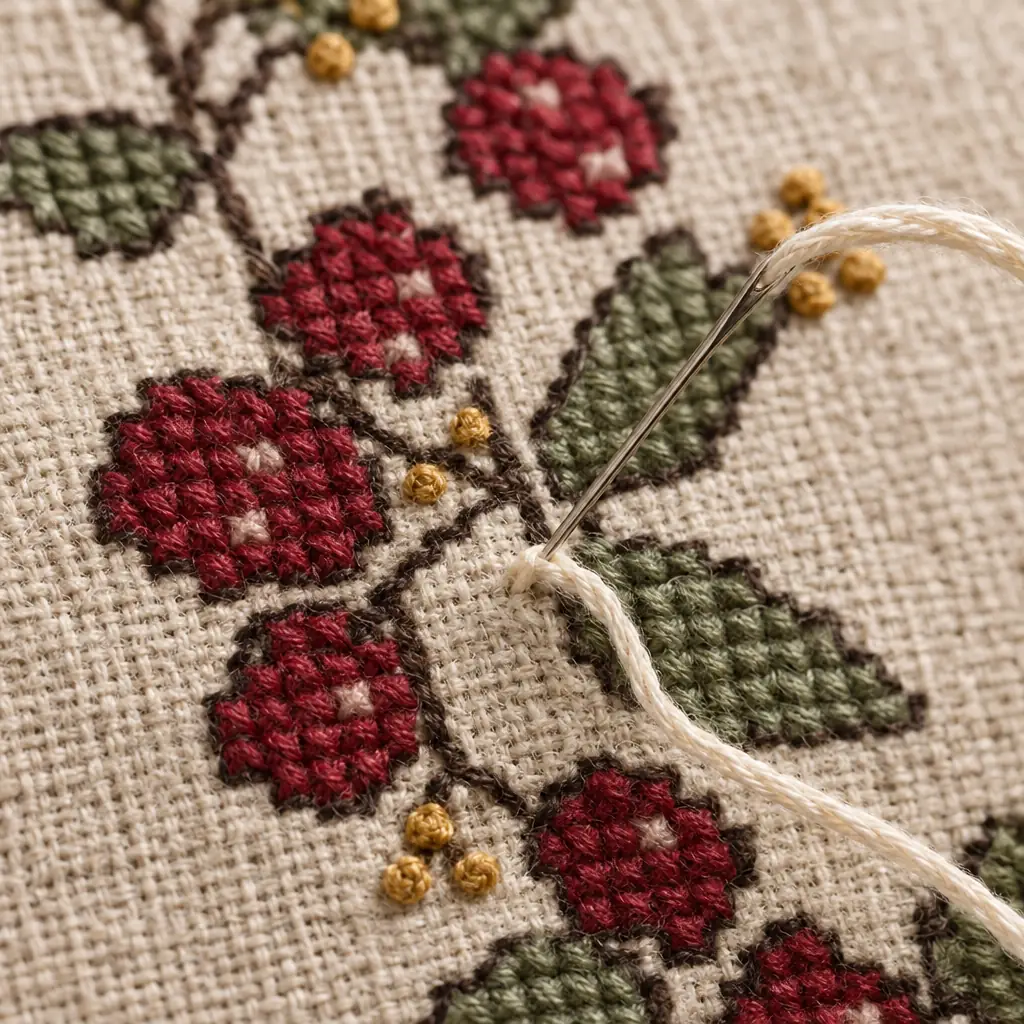
Why Does 28-Count Linen Behave Like 14-Count Aida?
Because linen and evenweave are commonly stitched over two fabric threads.
DMC explains that cross stitch on linen and evenweave is often worked over two thread intersections.
So:
28 fabric threads per inch ÷ 2 = 14 stitches per inch.
That gives us these useful equivalents:
| Aida | Linen/evenweave stitched over two |
|---|---|
| 14 count | 28 count |
| 16 count | 32 count |
| 18 count | 36 count |
This doesn’t mean the fabrics look identical.
It means the cross stitches can occupy approximately the same physical size.
What Count Should a Beginner Use?
Start with 14-count Aida unless your eyesight, pattern or personal preference points elsewhere.
Its holes are clearly defined, the stitch size is comfortable for many people, and a huge number of beginner patterns and kits are designed around it. DMC uses 14-count Aida in its own learning cross-stitch kit.
After that, try 16 count.
Then 18.
You will quickly develop a preference.
 Does Fabric Count Change Floss Coverage?
Yes.
A larger stitch generally requires more thread coverage than a smaller one.
Six-strand embroidery floss is designed so that you can separate the strands and adjust the amount of thread being used.
Your pattern should be the first authority on strand count.
When it doesn’t specify, make several test stitches.
Ask:
Does too much fabric show through?
Do the stitches feel crowded?
Do you like the appearance?
Needlework has conventions, but appearance and comfort still matter.
 Does Fabric Count Change Needle Size?
Usually.
Finer-count fabric has smaller openings, so stitchers normally move toward finer tapestry needles as fabric count increases.
DMC offers tapestry needles in several sizes from 22 through 28 for Aida and canvas-based needlework.
We’ll cover the common fabric-to-needle pairings separately in Cross Stitch Needle Sizes Explained.
Which Count Looks Best?
There isn’t one.
A lower count creates larger, more visible Xs.
A higher count creates a finer, more compact image.
A sampler on linen may benefit from visible fabric and delicate stitches.
A bold modern design might look fantastic on 14-count Aida.
A detailed full-coverage design may benefit from a higher count to keep the finished project manageable.
The design, your eyesight, your preferred stitch coverage and the desired finished size all matter.
 Cross Stitch Expo Quick Guide
Choose 11 count when you want large, easy-to-see stitch squares.
Choose 14 count for a comfortable all-purpose beginner fabric.
Choose 16 count for slightly smaller stitches without a dramatic jump in difficulty.
Choose 18 count for finer detail and a smaller finished project.
Choose 28-count linen/evenweave over two when you want approximately 14-count stitch sizing with a finer ground fabric.
Choose 32 count over two for approximately 16-count sizing.
Choose 36 count over two for approximately 18-count sizing.
 What to Learn Next
- Aida vs Linen vs Evenweave
- Cross Stitch Needle Sizes Explained
- How Many Strands of Floss Should You Use?
Once fabric count makes sense, many other cross-stitch decisions become easier.
Needle size.
Floss coverage.
Finished dimensions.
Framing.
Even pattern choice.
It is one small number that explains a surprising amount about the project.