Affiliate disclosure: Cross Stitch Expo may earn a commission from qualifying purchases made through links on this page, at no additional cost to you. How we choose what we feature.
The needle may be one of the smallest things in your project bag, but choosing the right one can make cross stitch noticeably more comfortable.
A needle that is too large can feel awkward passing through the fabric.
A needle that is unnecessarily fine can be harder to thread or may not comfortably accommodate the number of floss strands you’re using.
Fortunately, cross-stitch needle sizing is much easier to understand once you know one rule:
The higher the needle-size number, the finer the needle.
So a size 28 tapestry needle is finer than a size 24.
 The Quick Answer
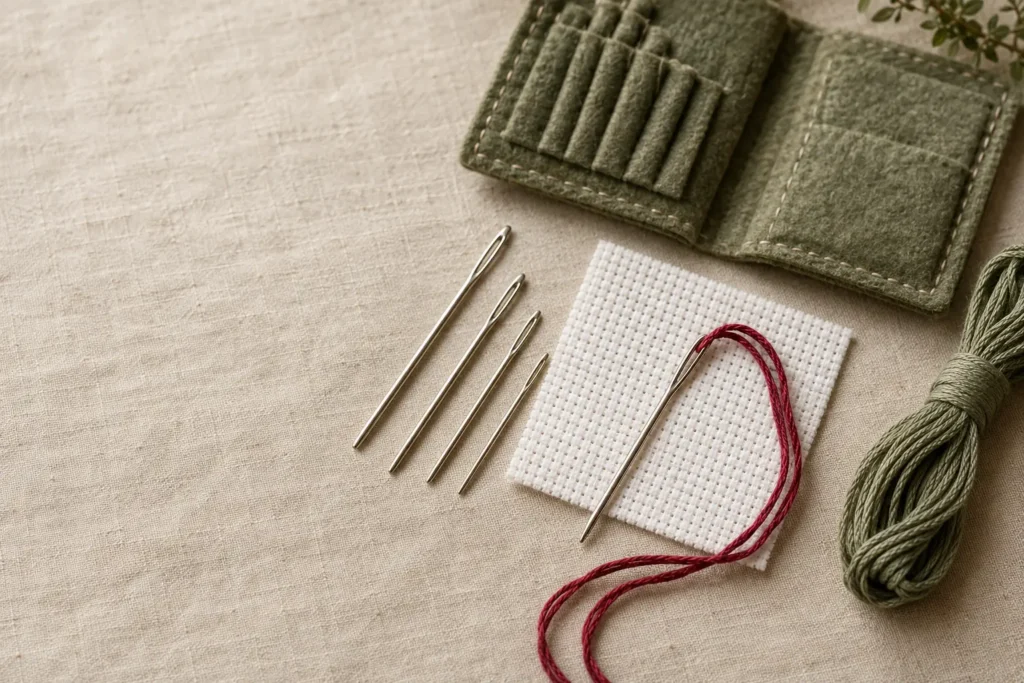
Cross stitch is normally worked with a tapestry needle.
Tapestry needles have a blunt tip and elongated eye. The blunt tip is useful because it passes through the existing holes in Aida or between the threads of evenweave and linen rather than intentionally piercing the fabric fibers. DMC likewise recommends a blunt-point cross-stitch needle as part of the basic cross-stitch toolkit.
A useful starting guide is:
| Fabric | Needle to try |
|---|---|
| 11-count Aida | Size 22 |
| 14-count Aida | Size 24 |
| 16-count Aida | Size 26 |
| 18-count Aida | Size 26 or 28 |
| 28-count evenweave/linen over two | Size 24 |
| 32-count evenweave/linen over two | Size 26 |
| 36-count evenweave/linen over two | Size 28 |
These are starting points rather than laws. Published recommendations differ slightly, particularly around 18-count fabric.
If your pattern or kit specifies a needle size, follow that recommendation first.
 Why Cross Stitch Uses a Tapestry Needle
A sharp sewing needle is designed to pierce fabric.
Cross stitch usually doesn’t need that.
Aida already has holes positioned exactly where the stitches belong.
Evenweave and linen have openings between the woven threads.
A tapestry needle’s rounded tip helps find those openings naturally.
That is especially useful when stitching near completed crosses because the blunt point is less likely to split an existing stitch.
What Do Needle Numbers Mean?
Needle numbering works in the opposite direction from what beginners often expect.
Smaller number = thicker needle
Larger number = finer needle
For example:
Size 22 is relatively substantial.
Size 24 is finer.
Size 26 is finer again.
Size 28 is commonly used for finer-count fabrics.
 Size 24: A Good 14-Count Starting Point
If you stitch on 14-count Aida, a size 24 tapestry needle is a widely used starting choice.
It normally has enough room in the eye for the common two-strand setup while still passing comfortably through the holes in the fabric.
That’s one reason a combination of:
14-count Aida + size 24 tapestry needle + two strands of floss
is such a useful beginner setup.
Size 26: Useful for Finer Fabric
A size 26 is a common choice for 16-count Aida and is also frequently used on 18-count Aida.
It is finer than a size 24, so it works well as the fabric holes become smaller.
Many stitchers also prefer a 26 on 32-count linen or evenweave when stitching over two threads.
 Size 28: For Fine Work
Size 28 tapestry needles are useful on finer fabrics.
They are often suggested for 36-count linen or evenweave worked over two, and some stitchers choose them on 18-count Aida as well.
Because the eye is smaller, make sure the amount and type of thread you’re using passes through comfortably.
 How Do You Know if the Needle Is Too Large?
Pay attention to the fabric.
If the needle:
- noticeably widens the holes,
- requires unnecessary force,
- distorts the weave,
- or feels bulky compared with the stitch,
- try a finer needle.
How Do You Know if It Is Too Fine?
A very fine needle isn’t automatically better.
If:
- threading becomes frustrating,
- your floss rubs excessively against the eye,
- the needle bends easily in your hand,
- or you are struggling to pull specialty fibers through,
- a slightly larger needle may be more comfortable.
Should You Always Follow a Needle Chart?
Use a chart as a starting point.
Then use the actual project as the final test.
Fabric varies.
Threads vary.
Needle brands vary.
And stitchers have personal preferences.
The correct needle is the one that comfortably holds the required thread and passes through the fabric without unnecessarily disturbing it.
When Should You Replace a Needle?
Needles don’t last forever.
Consider replacing one if it:
- becomes bent,
- develops a rough surface,
- begins catching the thread,
- feels unpleasant in your hand,
- or shows obvious discoloration or wear.
A fresh needle is inexpensive and can make a surprisingly noticeable difference.
Cross Stitch Expo Quick Guide
For many stitchers:
- 11-count Aida → try size 22
- 14-count Aida → try size 24
- 16-count Aida → try size 26
- 18-count Aida → try size 26 or 28
- 28-count over two → try size 24
- 32-count over two → try size 26
- 36-count over two → try size 28
Then adjust for your specific thread, fabric and comfort.
 What to Learn Next
- Cross Stitch Fabric Counts Explained
- How Many Strands of Floss Should You Use?
- Cross Stitch Supplies for Beginners
- Aida vs Linen vs Evenweave
The goal isn’t to memorize needle numbers.
It’s simply to recognize when the needle and fabric are working comfortably together.