Affiliate disclosure: Cross Stitch Expo may earn a commission from qualifying purchases made through links on this page, at no additional cost to you. How we choose what we feature.
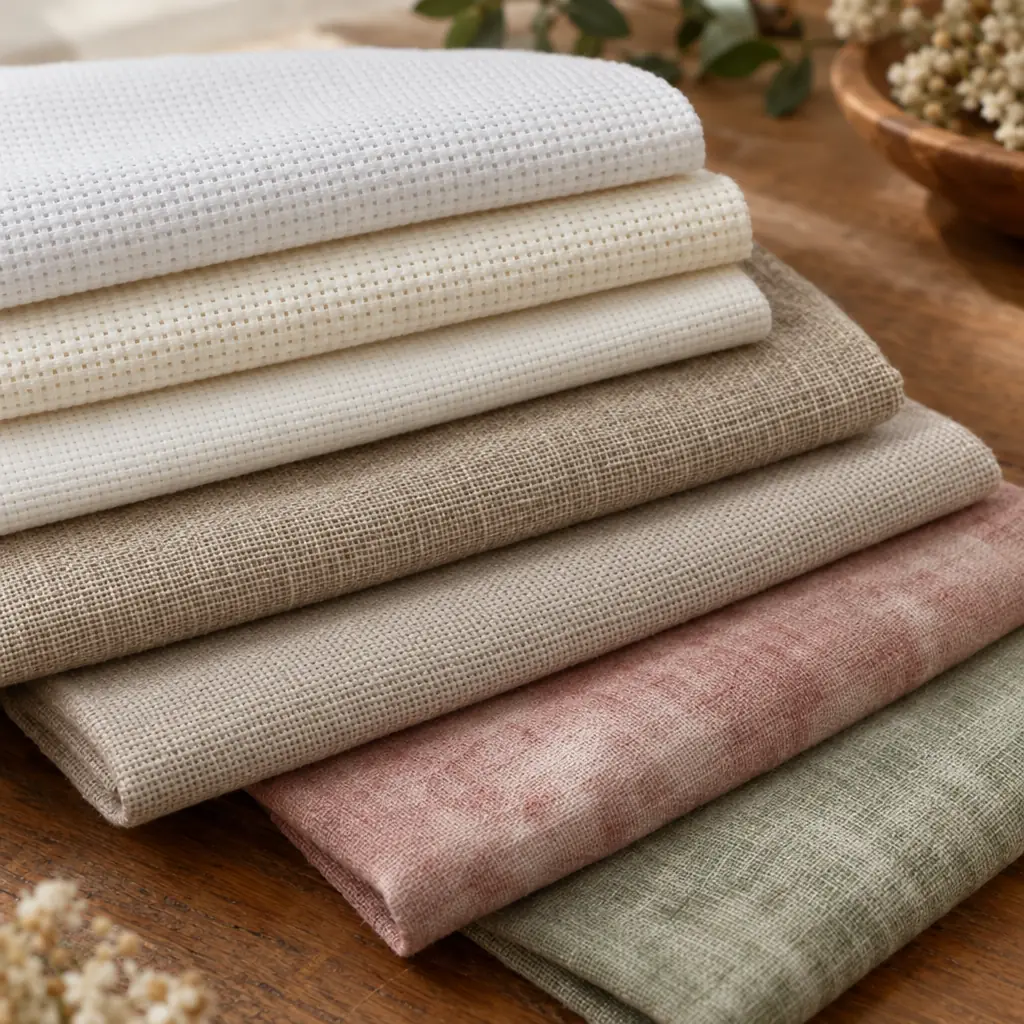
Fabric changes more than the background color of a cross-stitch project.
It affects how you count, how large the finished project becomes, how easy the holes are to see and the overall appearance of the finished piece.
Three names appear repeatedly in counted cross stitch:
- Aida
- Evenweave
- Linen
None is automatically better.
They simply create different stitching experiences.
 The Quick Recommendation
If you are brand new to counted cross stitch, start with 14-count Aida.
DMC recommends 14-count Aida for beginners, while Zweigart emphasizes Aida’s clearly formed stitch squares as an advantage for counting.
Once you are comfortable reading charts and placing stitches, experiment with evenweave or linen.
 What Is Aida?
Aida is woven specifically to create obvious stitch squares and visible holes.
You normally place one cross stitch over one Aida square.
That clear structure is why Aida is so popular with beginners—and why plenty of experienced stitchers continue using it.
Common counts include:
- 11-count
- 14-count
- 16-count
- 18-count
- 20-count
Zweigart currently offers Aida across several of these counts, including 14, 16, 18 and 20 count.
Choose Aida when:
You want easy-to-see stitch placement.
You are learning counted cross stitch.
The pattern calls for Aida.
You prefer a slightly more structured fabric.
You don’t want to count individual fabric threads.
What Is Evenweave?
Evenweave is a woven counted-thread fabric in which you generally count the fabric threads rather than obvious Aida blocks.
Cross stitch on evenweave is often worked over two fabric threads.
DMC’s stitch guide explains that linen and evenweave are commonly stitched over two intersections, whereas Aida presents clearly identifiable holes for the stitch.
That gives stitchers more flexibility.
For example, a 28-count evenweave worked over two creates approximately the same number of cross stitches per inch as 14-count Aida.
The fabric usually produces a finer-looking background than traditional Aida.
Choose evenweave when:
You want a smoother background.
You are comfortable counting fabric threads.
Your design contains fractional stitches.
You want more flexibility in stitch placement.
You like the appearance of linen but prefer a more regular weave.
What Is Linen?
Linen is a traditional natural-fiber needlework fabric with a distinctive texture.
It is available in many thread counts; Zweigart, for example, offers linen fabrics including 28, 32, 36, 40 and higher counts.
Like evenweave, linen cross stitch is commonly worked over two fabric threads.
A 28-count linen stitched over two produces approximately 14 cross stitches per inch.
A 32-count linen over two produces approximately 16.
A 36-count linen over two produces approximately 18.
Choose linen when:
You enjoy a traditional or refined needlework appearance.
You are comfortable counting individual fabric threads.
You want the fabric itself to contribute visible texture and character.
You are stitching samplers or projects where the background fabric is an important visual part of the finished piece.
Aida vs Evenweave vs Linen at a Glance
| Feature | Aida | Evenweave | Linen |
|---|---|---|---|
| Beginner friendly | Excellent | Good after some experience | Better after some experience |
| Stitch placement | Clear blocks | Count threads | Count threads |
| Common method | Over one square | Often over two threads | Often over two threads |
| Background look | Structured | Smooth/refined | Natural/textured |
| Fractional stitches | Possible but sometimes less convenient | Flexible | Flexible |
| Good first choice | Yes | Later | Later |
What Does “Over Two” Mean?
On 28-count linen or evenweave, there are 28 fabric threads per inch.
If each cross stitch spans two threads horizontally and two vertically, you effectively create 14 crosses per inch.
That’s why:
- 28-count over two ≈ 14-count Aida
- 32-count over two ≈ 16-count Aida
- 36-count over two ≈ 18-count Aida
This relationship also means a pattern can often retain approximately the same finished dimensions when moving between equivalent counts.
Is Linen More Difficult?
It requires a different kind of counting.
Instead of putting every X into an obvious square, you identify fabric-thread intersections.
At first that can feel slower.
But once your eye adjusts, it becomes much more natural.
If you are curious about linen, don’t wait until you consider yourself an “advanced stitcher.”
Try a small project.
The best way to understand a fabric is to stitch on it.
 Does the Pattern Decide?
Often, yes.
Designers may recommend a particular fabric because:
- The color supports the design
- The count produces the intended finished size
- Specialty stitches work better on it
- The visible background contributes to the artwork
You can substitute fabric, but understand what the substitution changes.
 Cross Stitch Expo Recommendation
Choose:
14-count Aida if this is your first project.
16- or 18-count Aida if you like Aida but want smaller, finer stitches.
28- or 32-count evenweave if you want to explore over-two stitching on a regular fabric.
28- or 32-count linen if you want a more traditional textured ground.
Most importantly, choose a fabric you can see comfortably.
A technically beautiful fabric is not the right fabric if stitching on it makes the project unpleasant.
 What to Learn Next
- Cross Stitch Fabric Counts Explained
- Cross Stitch Needle Sizes Explained
- How Many Strands of Floss Should You Use?
- How to Choose Your First Pattern
Fabric is not simply what holds the stitches.
It is part of the finished design.
Experiment until you discover the surface you enjoy stitching on—not merely the one you think you’re supposed to use.