Affiliate disclosure: Cross Stitch Expo may earn a commission from qualifying purchases made through links on this page, at no additional cost to you. How we choose what we feature.
There is a point in almost every stitcher’s life when “my embroidery floss” becomes:
my embroidery floss situation.
One project turns into five.
A handful of skeins becomes dozens.
Leftover lengths accumulate.
Suddenly you own three shades of blue that look identical until the pattern calls for one specific number.
Good organization isn’t about making your craft room look perfect.
It is about answering three questions quickly:
- What do I own?
- Where is it?
- Which project is using it?
 Method 1: Bobbins
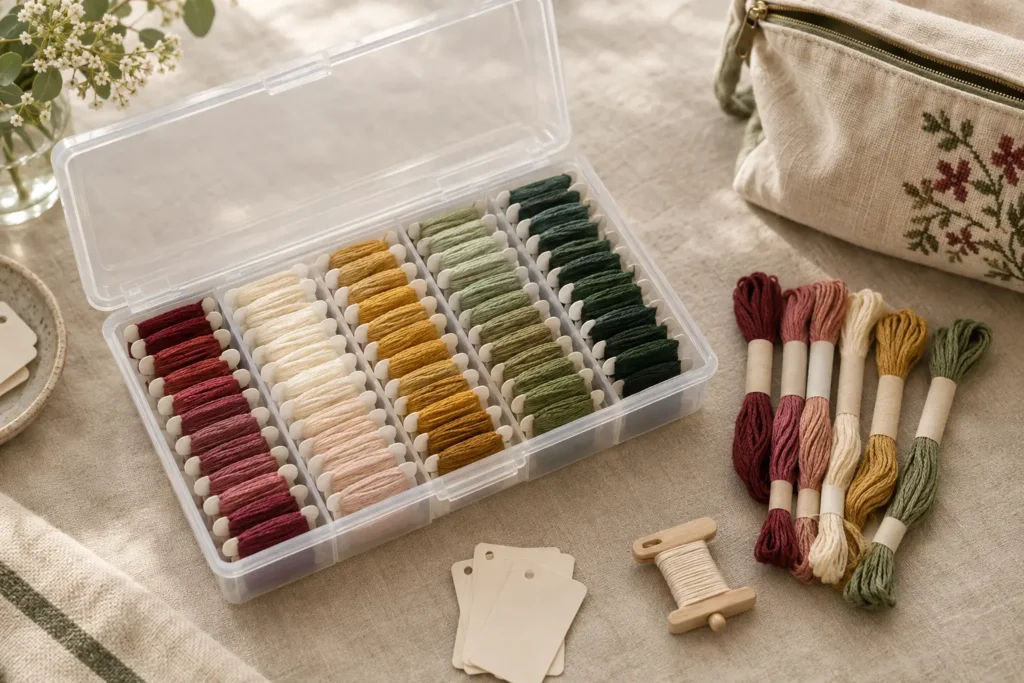
Bobbins remain one of the most familiar floss-storage systems.
Wind each skein onto a small cardboard or plastic bobbin.
Label it with the thread number.
Store the bobbins upright in boxes or drawers.
DMC currently sells both plastic and cardboard bobbins, number labels and organizer rings specifically for this approach.
Advantages
- Compact
- Easy to sort numerically
- Easy to see colors
- Works well in shallow storage boxes
Tradeoffs
- Winding takes time
- Thread can develop bends after long storage
- Loose working lengths still need somewhere to go
 Method 2: Floss Drops
Floss drops hold thread in loops rather than tightly winding it.
Each drop can be labeled with the color number.
Advantages
- Fast access
- No bobbin winding
- Easy to pull individual strands
- Useful with specialty and hand-dyed threads
Tradeoffs
- Takes more physical space
- Loose threads can become tangled if storage is poorly designed
Method 3: Individual Bags
Small zip bags can hold:
- the full skein,
- leftover lengths,
- the label,
- and sometimes even the thread card.
Advantages
- Nothing needs winding
- Loose scraps stay with the original color
- Good for specialty threads
Tradeoffs
- Bulkier
- Large collections need substantial storage
- Finding one shade can be slower unless the bags are filed systematically
Method 4: StitchBow-Style Storage
Long thread holders preserve the skein in a straighter configuration.
DMC includes StitchBows as part of its current thread-care accessory range.
This approach can work well if you dislike winding but want more structure than loose skeins.
Method 5: Keep Skeins Intact
There is nothing wrong with storing thread as it comes from the manufacturer.
Use drawers, bins or divided boxes.
Sort by:
- number,
- color family,
- thread type,
- or brand.
The key is maintaining the identifying band.
Without the number, that lovely medium green can become surprisingly difficult to identify six months later.
Organize by Number or Color?
For charted cross stitch:
number usually wins.
If a pattern calls for DMC 3347, you want to find 3347.
Sorting only by visual color can look beautiful but slow down project setup.
A good compromise:
- sort broadly by number range,
- then arrange neatly within each section.
Keep Project Floss Separate
Once you’ve pulled colors for an active project, put them together.
DMC’s bobbin-and-ring system is specifically designed to group threads for a particular project or color palette.
A project bag might contain:
- pattern,
- fabric,
- needles,
- required floss,
- and a small thread organizer.
That prevents constantly returning to the main stash.
What Do You Do With Leftover Lengths?
Don’t throw away six useful inches of thread.
But don’t create a mystery nest either.
Put the leftover thread:
- back onto the correct bobbin,
- through the correct floss drop,
- inside the labeled bag,
- or onto the project’s thread card.
Never rely on:
“I’ll remember which red this is.”
You probably won’t.
Keep Different Thread Types Separate
Consider separate storage for:
- standard cotton,
- metallics,
- silks,
- hand-dyed threads,
- wool,
- and specialty fibers.
That makes it easier to protect and inventory more delicate materials.
Build an Inventory
Once your stash becomes significant, keep a simple record.
You can use:
- a notebook,
- spreadsheet,
- inventory app,
- or printed DMC color checklist.
Record:
- thread number,
- quantity,
- location,
- and whether a skein is already committed to a project.
This is particularly useful when shopping.
The cheapest skein is the one you discover you already own.
 Don’t Organize More Than You Stitch
Storage can become its own hobby.
That’s fine if you enjoy it.
But don’t convince yourself that every skein must be rewound, photographed, labeled, cataloged and color-coded before you can begin your next project.
Choose the simplest system that lets you find what you need.
 Cross Stitch Expo Recommendation
For a modest DMC collection:
labeled bobbins in numerical order
is inexpensive and efficient.
For large collections or hand-dyed fibers:
consider floss drops or labeled bags.
For active projects:
keep the required colors together on a ring, thread card or project organizer.
Your organization system should remove friction from stitching.
Not create another unfinished project.