Affiliate disclosure: Cross Stitch Expo may earn a commission from qualifying purchases made through links on this page, at no additional cost to you. How we choose what we feature.
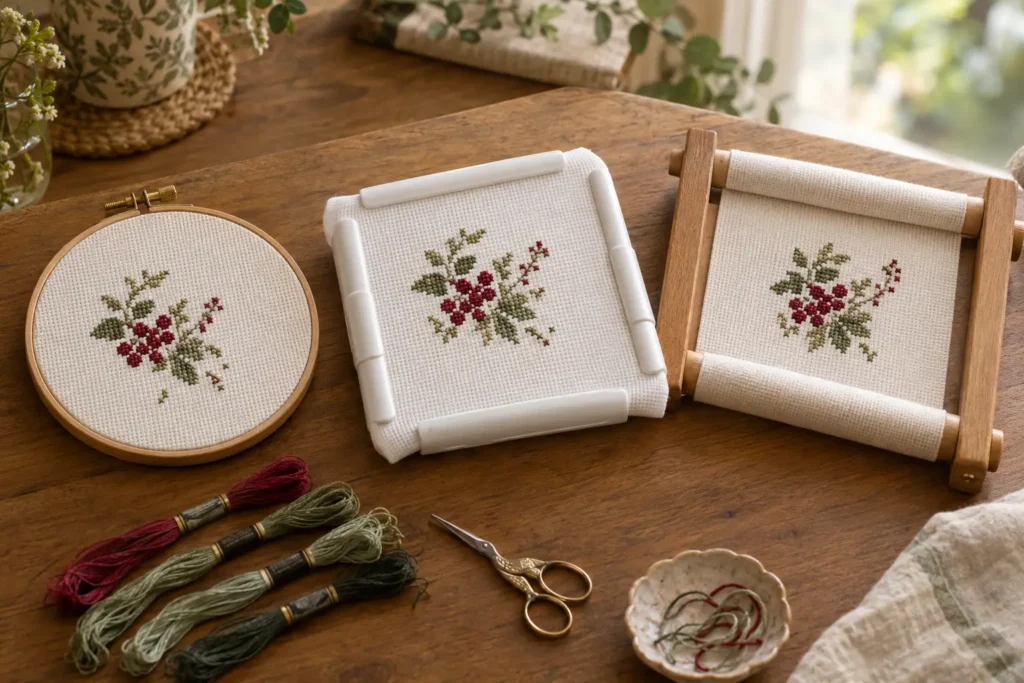
Cross stitch can be worked:
- in a hoop,
- in a Q-Snap,
- on a scroll frame,
- or even in hand.
None is automatically correct.
The best system depends on:
- project size,
- fabric,
- how you hold your work,
- how much tension you prefer,
- and where you stitch.
 The Quick Comparison
| Holder | Best feature | Main tradeoff |
|---|---|---|
| Hoop | Simple and inexpensive | Limited working area |
| Q-Snap | Lightweight, even clamp tension | Bulkier than a hoop |
| Scroll frame | Large area stays mounted | Less portable |
| In hand | No equipment | Tension depends entirely on technique |
 Embroidery Hoop
A hoop consists of two rings.
The fabric sits between them and is tightened to create tension.
DMC describes hoops as an inexpensive way to hold fabric taut and make consistent stitching easier.
Advantages
- Easy to find
- Inexpensive
- Portable
- Available in many sizes
- Fast to reposition
Tradeoffs
- The working area is limited
- You may need to move the hoop frequently
Hoop pressure can create creases if work is left mounted for extended periods. DMC specifically recommends not leaving work in a hoop for too long for this reason.
Best for
- Beginners
- Small and medium projects
- Travel stitching
- Stitchers who like firm tension
 Q-Snap
A Q-Snap is a lightweight square or rectangular frame that uses clamp pieces to hold the fabric around tubular sides.
The manufacturer says its original needlework frames are designed primarily for cross stitch and embroidery, with sizes from 6 × 6 inches through 20 × 20 inches. Ribbed clamps secure the fabric.
Advantages
- Good working area
- Lightweight compared with many rigid frames
- No round hoop ring
- Easy to assemble
- Can provide even tension across a broad area
Tradeoffs
- Larger sizes can become awkward to hold
- Clamps may need adjustment
- Excess fabric around a small project needs to be managed
- Some stitchers prefer a stand when the frame gets large
Best for
- Medium projects
- Stitchers who prefer square working areas
- People who dislike hoop rings
- Projects where you want more visible fabric at once
Scroll Frame
A scroll frame usually holds two opposite edges of the fabric on horizontal rods.
As the project progresses, the fabric can be advanced by rolling it.
DMC recommends larger frames as useful options for larger projects.
Advantages
- A large project can remain mounted
- You can expose a wide working area
- Less repeated repositioning of a hoop
- Works well with stands
- Useful for long samplers and larger designs
Tradeoffs
- Less portable
- Setup takes longer
- Side tension may feel different from hoop or Q-Snap tension
- Large frames can be tiring to hold without support
Best for
- Large samplers
- Long-term projects
- Wide designs
- Stitchers using tabletop or floor stands
What About Stitching in Hand?
Some stitchers use no frame at all.
The fabric is held and folded as necessary.
Advantages
- Nothing to set up
- Extremely portable
- No hoop marks
- Fast access to the entire fabric
Tradeoffs
- You control all tension manually
- The fabric can become more handled
- Some stitchers find it harder to create consistent stitches
 Which Is Best for a Beginner?
Start with a hoop unless you already know you dislike one.
It is:
- cheap,
- easy to understand,
- and widely available.
Then try a small Q-Snap.
The comparison will teach you more than reading twenty opinions.
Which Is Best for a Large Project?
A scroll frame or larger Q-Snap may reduce repeated repositioning.
If the project will be mounted for months, also consider:
- how you’ll protect excess fabric,
- whether you’ll use a stand,
- and how much physical weight you want in your hands.
Does Tight Tension Mean Better Stitches?
Not necessarily.
You want the fabric stable.
You do not want it stretched so tightly that:
- holes distort,
- fabric warps,
- or stitches become unnaturally tight.
DMC advises even tension and warns that stitches pulled too tightly can pucker the fabric.
 Cross Stitch Expo Recommendation
For a first project:
Hoop
For a medium project where you want more visible working area:
Q-Snap
For a large long-term project:
Scroll frame
For experienced stitchers who enjoy flexibility:
Try stitching in hand
But don’t turn the holder into a status symbol.
The best frame is the one that lets you stitch comfortably.